
Coming together to celebrate diversity, inclusion and love for a good book
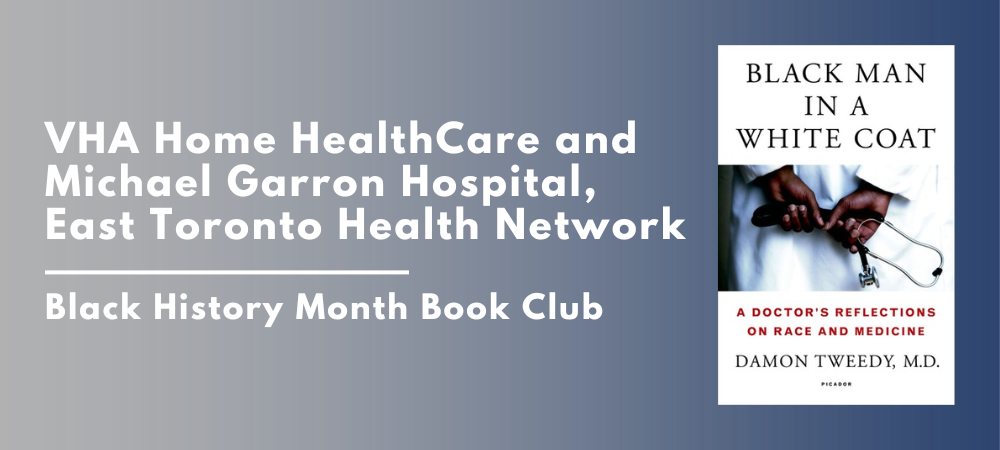
For the second year in a row, employees from both Michael Garron Hospital, Toronto East Health Network, and VHA Home HealthCare (VHA) came together to take part in an engaging and insightful book club as part of Black History Month in February. For this year’s meetings, the novel “Black Man in a White Coat” by Dr. Damon Tweedy was selected.
Throughout the course of three lunchtime meetings, a group consisting of personnel gathering both in person and online converged to discuss Dr. Tweedy’s observations on how both Black doctors and patients often need to navigate the difficult and sometimes contradictory world of medicine. Group members shared their own experiences and reflected on how even though the book takes place in the American south, it isn’t necessarily as different from the reality in Canada that some might expect.
History, culture, personal biases and socioeconomic divisions all play a role in creating a healthcare system where Black patients are not only at risk of receiving less equitable care but are more vulnerable to lifestyle conditions which cause future health problems. The concept that “being Black can be bad for your health” is reinforced several times throughout the book with data showing that Black Americans face higher risk for conditions such as hypertension and diabetes.
Dr. Tweedy took the club on a journey beginning as a medical student, moving into a medical resident and transforming into a knowledgeable medical professional. His interactions, many based in assumptions and stereotypes, led us from his experience being mistaken for a maintenance worker when attending a lecture in school to being assigned black patients under the false belief that he would naturally have a better rapport with them.
“What stood out most, for me, was how powerful honest communication can be. As a group, we explored the realities of bias, mistrust, and representation in healthcare. It challenged us to think more intentionally about the care we provide and the systems we work within,” shared Ola, one book club member.
Through his experiences, he challenged his own preconceptions and encouraged us to do the same. By connecting his readers with his own experiences, Dr. Tweedy made it easier for our group to share our own. Group members spoke of their own experiences navigating health care and the difficulties they’ve experienced. One spoke to their experiences dressing up in “nice clothes” when visiting the Emergency Department in their attempt to be taken more seriously as a patient, while another recalled being treated as “difficult” by her physician after telling them about an independent diabetes resource she had reached out to.
Beyond speaking to direct heath care interventions, Dr. Tweedy looks deeper into the cause of many health issues, which can be routed in diet, stress or even the reluctance to seek help when an individual lacks insurance. As he shared his own experiences, he also shared those of memorable patients. In one notable example, he compares two similar patients with two very different outcomes: one patient who did not make necessary lifestyle changes and suffered a massive stroke to another who made the conscious choice to begin eating better and exercising. Through comparisons like this, Dr. Tweedy emphasizes the importance of playing an active role in one’s own health. Especially in a system where the scales are not always equitable. At the end of the novel, a clear question arises; how do we improve health care and access to health care for Black patients? Dr. Tweedy states there are two schools of thought: The first is advocating for the collection of race/ethnicity data to monitor for disparities, expanded cultural competency training, and broaden the diversity of physicians. The second is to improve the quality of care for everyone, which would significantly benefit Black patients who often have worse health and receive a lower quality of care. He suggests that this doesn’t need to be a “one or the other” proposition but that both can be pursued in tandem. “If the goal is to improve the health of Black people, who remain at the bottom of most health indexes, it shouldn’t matter whether the means to achieving this follows a liberal strategy, a conservative approach, or something in between.”
The small but mighty book club agrees. There likely isn’t one single answer to fix all disparities when it comes to health care and access to health care for Black patients. Rather, an adaptive and flexible approach built on understanding, compassion and personal connection is – and will continue to be – needed as we move forward towards a better and more equitable health care system.
As we continue to ponder these thoughts and what we can personally do to help make the health care world we live in better and more inclusive, the joint Michael Garron Hospital/VHA Home HealthCare book club eagerly wait for our next paperback to dig into.